
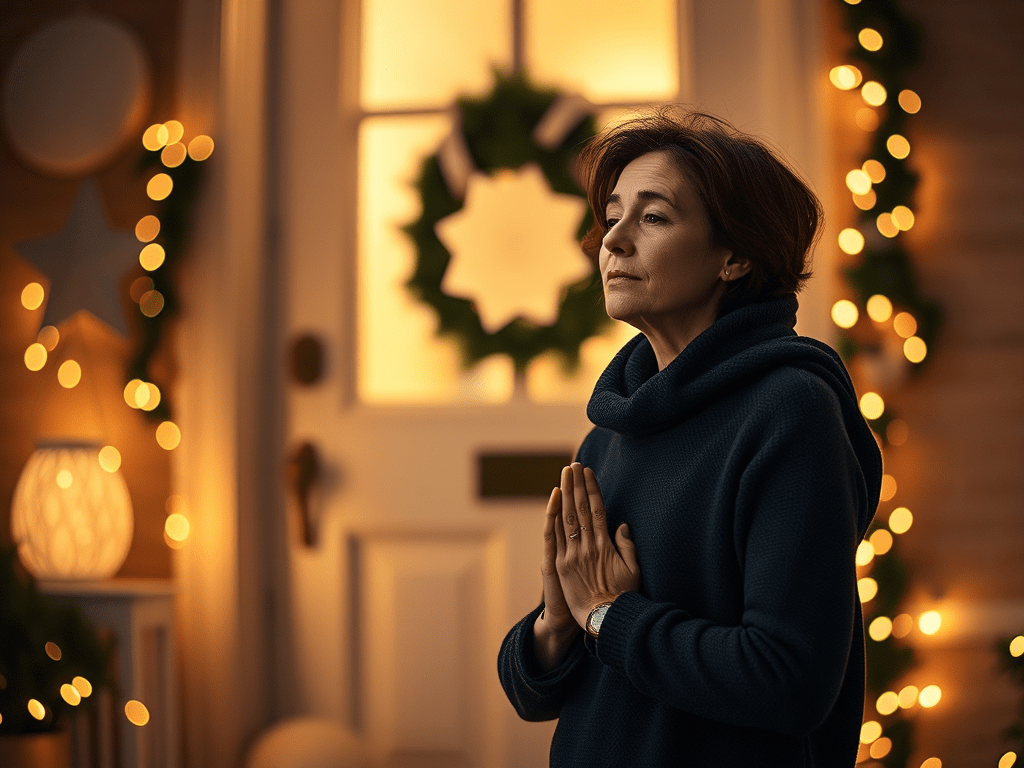
You know that feeling when your hand is on the doorknob and your whole body suddenly remembers every other time you walked through that door?
The week before a holiday, a lot of us start to feel the old rooms before we even get there. Maybe it’s your childhood home, a relative’s house, a church, a workplace, or even just a place that carries the scent of someone who hurt you. The smells, the lighting, the way the floor feels under your shoes—your nervous system remembers what your mind has tried to move past.
If you’re feeling holiday anxiety before anything “bad” actually happens, I want you to hear this clearly:
Nothing is wrong with you.
Your body is trying to keep you safe.
For trauma survivors and people with CPTSD, stepping into familiar places can be more triggering than new ones. The brain connects those rooms with old danger. Even if everyone is “being nice now,” your body still scans for threat.
Today, I want to give you a 5-minute doorway practice you can use anywhere this season: homes, offices, stores, parties, even your own front door when you’re exhausted from it all.
You don’t have to feel fully calm.
You just need a way to walk in without abandoning yourself.
5-Minute Doorway Grounding Practice
You can use this anytime you’re about to walk into a place that makes your stomach flip or your chest tighten.
Step 1: Pause before you cross the threshold (1 minute).
Stop just outside the room or right inside the door. Let your feet be still. Notice the surface under you: carpet, wood, concrete, tile. Feel the weight of your body dropping into your feet. You don’t need to “relax.” Just notice: I have feet. The floor is holding me.
If it helps, gently press your toes into the ground and imagine a little extra weight traveling down, out of your head and into your legs.
Step 2: Put your hands on your body (1 minute).
Place one hand on your chest and one hand on your ribs or belly. This is about letting your nervous system know: “I haven’t left you. I’m here.”
Take a slow inhale through your nose for a count of 4. Hold for 2. Exhale through your mouth for a count of 6, like you’re gently sighing. You don’t have to count perfectly. Just let the exhale be longer than the inhale.
On the exhale, think:
“I can notice my holiday triggers and stay on my own side.”
Repeat this breath pattern 3–5 times.
Step 3: Find one anchor in the room (1–2 minutes).
Let your eyes move away from the people and land on something neutral: a plant, a picture frame, a window, a lamp. Let yourself really look at it for a few breaths. Notice colors, shapes, texture. This is called “orienting” and it helps your body realize it is here, now, not back then.
If you feel your mind racing, that’s okay. Just keep coming back to this one object: This is my anchor. I can look at this when I feel overwhelmed.
Step 4: Give yourself one small boundary (1 minute).
Before you fully step in, quietly decide on one boundary that will help your nervous system feel a little safer. It might be:
- “I will step outside for a breath if the conversation turns to to a triggering subject.”
- “I do not have to answer questions that make me feel exposed.”
- “I will stay for one hour and then go home.”
You don’t have to announce it to anyone. You just need an inner agreement with yourself: My body matters more than their expectations.
That’s it. That’s the practice.
You’re not trying to erase your history with this doorway ritual. You’re giving your nervous system 5 minutes of care before you ask it to walk into a place it remembers as dangerous.
Gentle Journal Prompts
If you want to go a little deeper after you get home, or in the car before you go in, you can jot down:
- “What is my body bracing for when I walk into this place?”
- “What is one thing I will do differently this year to stay on my own side?”
- “Who feels safest in this room, and how can I move closer to that safety (even if it’s to myself in another room)?”
If your nervous system is too flooded to write full answers, bullet points are enough. A single sentence is enough. Even a few words are enough.
If you want more support with holiday triggers and familiar rooms, a few resources fit beautifully with this practice:
- Book: Anchored by Deb Dana is an incredible companion if you want more nervous system tools you can use in real time; car, bathroom, hallway, anywhere. It takes the big science of polyvagal theory and turns it into simple steps you can actually remember when you’re stressed.
- Journal: My Self-Regulation Journal on Etsy is a printable workbook you can use before or after these gatherings. It walks you through what triggered you, what your body did, and one small thing you can try next time. It’s made for people who leave events thinking “What is wrong with me?” and need a softer story.
- Holiday Book List: I also created a Holiday Nervous System Survival Book List on Amazon that gathers seven trauma-informed books for holiday anxiety, toxic family holidays, CPTSD triggers, and co-parenting stress. You don’t need all of them. Just start with the one your body keeps thinking about.
And if your history in these rooms includes covert abuse, confusing love, or feeling half-loved and fully confused, my free ebook Half Loved, Fully Confused is free and here to help you see those patterns more clearly on paper without shaming yourself.
You deserve to walk into all spaces old and new knowing you have your own back.
Leave a comment