
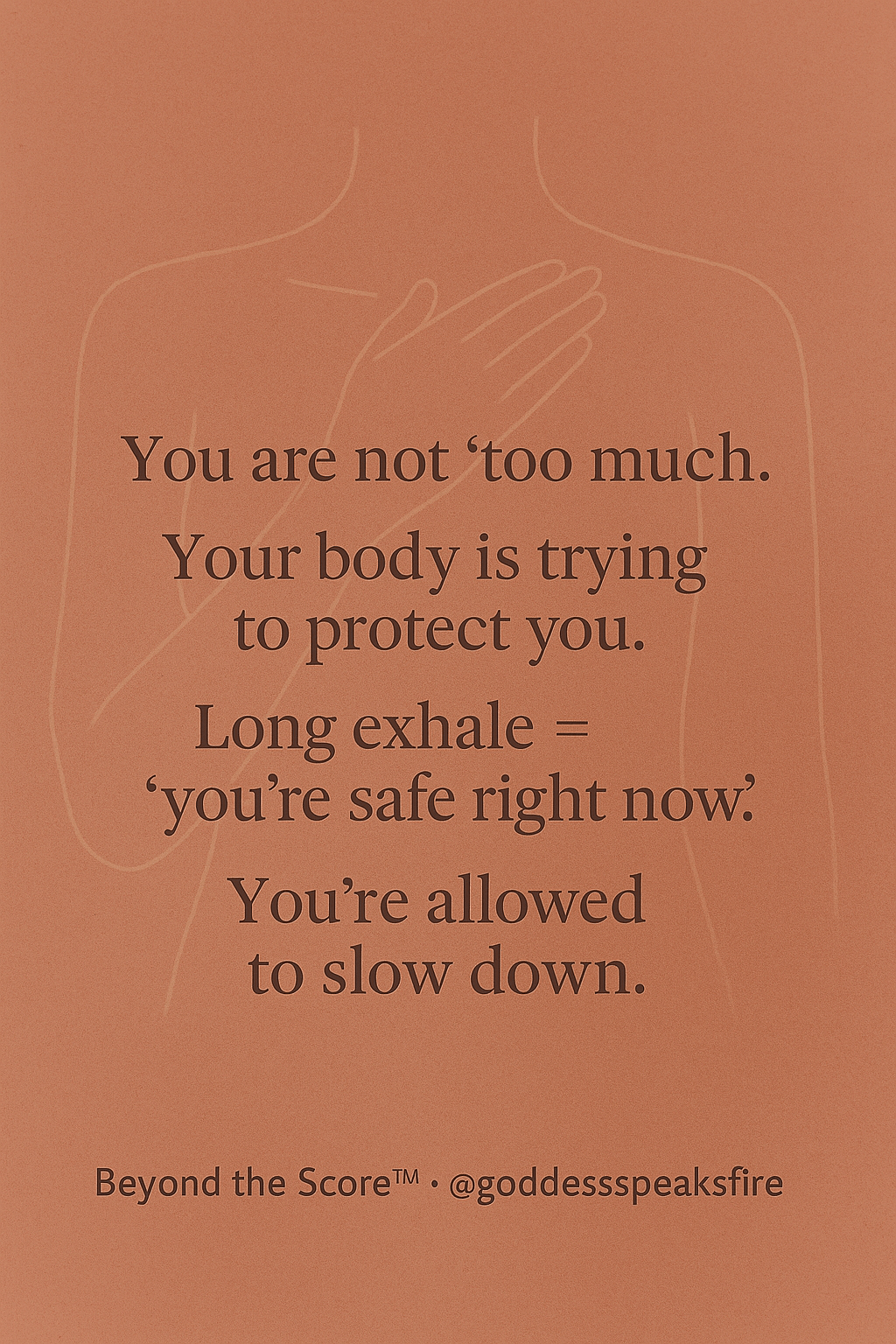
This one-minute breathing pattern helps calm panic, slow your heart rate, and bring you back into your body without shame. Step-by-step instructions inside.
When Your Body Is Screaming and You Still Have to Function
There are moments where your body goes into full alarm. Chest tight. Thoughts racing. Hands shaky. You can’t think clearly, but you’re still expected to answer messages, finish work, get the kids where they need to be, not fall apart.
In those moments, someone telling you “just calm down” is useless.
What your body actually needs is a safety signal. Something that tells your nervous system, in real time, “you are not actively in danger right now.” You can’t logic your way into that state. You have to send it through the body.
One of the fastest ways to do that is a practice called alternate nostril breathing. In yoga it’s called Anulom Vilom pranayama. It’s gentle, it doesn’t require equipment, and it usually takes about a minute.
Before we get into how, here’s what it’s for.
When your body is overwhelmed, your system tilts toward fight, flight, or freeze. Your heart rate goes up, your breathing gets shallow, and your mind starts scanning for every possible threat. This is survival biology.
Alternate nostril breathing helps rebalance that. The pattern and the slower exhale send a message to the part of your nervous system responsible for settling and restoring. You’re telling your body, “I can stand down for a second.”
How to do it (step-by-step)
Sit in whatever position is comfortable. You do not have to sit perfectly straight. Just drop your shoulders and unclench your jaw. Take your right hand. Your thumb will gently cover your right nostril. Your ring finger will gently cover your left nostril. You’ll be opening and closing each side with those two fingers. Close your right nostril with your thumb. Inhale slowly through your left nostril. Count to four in your head. Now close your left nostril with your ring finger. Release your right nostril. Exhale out of your right nostril. Count to six. Stay on that right side. Inhale through your right nostril for a slow count of four. Close your right nostril with your thumb again. Open the left side. Exhale out of the left nostril for a slow count of six.
That is one full round.
Do four to six rounds. That’s about a minute.
Why this works
The slightly longer exhale is the key. A long, slow exhale tells the body “you are not in immediate danger,” which supports lowering heart rate and gives you back access to clear thinking, language, and choice instead of pure reaction.
This helps when:
• You feel panic rising in your chest or throat
• You’re replaying a memory and can’t stop
• You’re about to text or call someone from a place of fear or abandonment
• You’ve gone numb and you just want to come back into your body without hurting yourself
What to tell yourself while you breathe
Pick one line and repeat it silently while you do the practice:
• I am allowed to slow down.
• My body is trying to protect me.
• This moment is mine.
Important notes
If you feel dizzy, stop and return to normal breathing. This is not supposed to feel like you’re starving for air. It should feel steady and kind. You are not in trouble if it’s hard. Your body has been holding a lot.
This is nervous system care. Your body is brilliant.
If you’re currently in an unsafe situation, your body might refuse to fully relax because it’s still trying to keep you alive. Use this technique for any relief it can give you in the moment, and also please get support if you are not safe.
Why I teach this
My book, Beyond the Score, is about real regulation for real people. Not “fix yourself.” Not “be calmer so you’re easier to deal with.”
It’s: you deserve access to your own body again.
Save this. Send it to someone who spirals alone. And the next time your body is screaming and you still have to function, try this first.
Leave a comment